Required Documents for Police Clearance 2026 (Complete Checklist Philippines)
Getting a Police Clearance in the Philippines is now faster and more convenient than ever before. However, the most common reason people face delays — or worse, get sent home — is that they forgot to bring the right documents.
Whether you are applying for a new job, a government ID, a bank account, or a work visa abroad, this guide has everything you need. We will walk you through every required document step by step, so your appointment day is smooth and stress-free.
Always use the official portal at policeclearanceinfo.ph to register and book your appointment safely.
What Are the Required Documents for National Police Clearance?
When we talk about “required documents,” we mean the official papers that prove who you are. The Philippine National Police (PNP) uses a centralized system called the National Police Clearance System (NPCS). This system checks your identity against a nationwide database to confirm you have no criminal or derogatory record.
Without the correct documents, the police cannot verify your record. In 2026, the system has become stricter about identity verification — so making sure your IDs are updated, clear, and match your online profile is more important than ever.
Most applicants only need three things:
- At least two (2) valid government-issued IDs (original copies)
- Reference number from your NPCS account
- Proof of payment (receipt or screenshot)
Special cases may need extra documents, which we will cover below.
Basic Requirements for Police Clearance Online Appointment 2026
Before visiting the police station, you must complete your online registration. The digital steps are just as important as the physical documents you bring.
Valid Government-Issued IDs Accepted
Your ID is the most critical document. Bring two (2) original, unexpired government-issued IDs. Each ID must clearly show:
- Your full legal name (exactly as typed in your NPCS profile)
- A clear photo
- Your signature
This is very important — even a small spelling difference between your ID and your online profile can trigger a “HIT” in the system, causing unnecessary delays even if you have a completely clean record.
Pro Tip: If your ID says “Ma.” but your profile says “Maria,” fix this before your appointment day to avoid problems.
Proof of Payment and Reference Number
After booking your appointment online, pay the Police Clearance fee through the Landbank ePayment portal. Other accepted payment methods include GCash, Maya, 7-Eleven CLiQQ, and credit or debit cards.
The base fee is ₱150, and with convenience fees, the total is usually around ₱160 to ₱180.
Once paid, you will receive a reference number and a payment receipt. Save both on your phone or print them out. The station officer will check these before starting your biometrics.
Additional Supporting Documents (If Applicable)
Some applicants may need to bring extra paperwork. For example:
- First-time job seekers need a Barangay Certificate
- Minors need a parent or guardian to accompany them
- Foreign nationals need their passport and ACR Card
- Applicants with name issues may need a PSA Birth Certificate
We will explain each of these in detail below.
Complete List of Accepted Valid IDs for Police Clearance
Not every card in your wallet counts as a “valid ID.” Here is a clear breakdown of what is accepted at most police stations.
Primary IDs (Preferred)
These are the strongest and most trusted IDs because they contain biometric data, a QR code, and a government seal:
- PhilSys National ID or ePhilID — The official national identity card or its digital version on the eGovPH app
- Philippine Passport — Issued by the DFA
- Driver’s License — From the LTO (Student Permit in card format is also accepted)
- UMID or MySSS Card — SSS or GSIS-issued; note that the MySSS Card with EMV chip is the 2026 replacement for the old UMID
- PRC ID — For licensed professionals
- Postal ID — The modernized version with a QR code
Secondary IDs (Alternative Options)
If you do not have two primary IDs, you can combine one primary and one secondary, or use two secondary IDs (depending on the strictness of your chosen station):
- PhilHealth ID
- TIN ID (digitized ORUS version recommended)
- Voter’s ID or COMELEC certificate
- Senior Citizen ID
- PWD ID
- Pag-IBIG ID
- School ID (for current students, usually with proof of enrollment)
Important: Always bring the strongest IDs you have. Photocopies are not accepted as a primary identification at the station — originals only.
Required Documents for Special Applicants
Certain groups of applicants have unique requirements. Here is what you need to know:
First-Time Job Seekers (RA 11261 – Fee Exemption)
Under Republic Act 11261, or the First-Time Jobseekers Assistance Act, qualified applicants can get their Police Clearance completely free — but only once. To qualify, you must bring a Barangay Certificate that:
- Confirms you are a first-time job seeker
- States you have been a resident of that barangay for at least six months
Without this certificate, the regular ₱150 fee will apply. You can get this certificate easily from your local Barangay Hall at no cost.
PWD (Persons with Disability) Applicants
PWD applicants should bring their valid PWD ID along with their regular government-issued ID. At many stations, PWD applicants are given priority assistance and seating during the biometrics capture process.
Minors Applying with Guardian
Applicants under 18 years old may apply in special cases. They must:
- Bring their PSA Birth Certificate
- Be accompanied by a parent or legal guardian with a valid ID
- Provide proof of the reason for needing the clearance (some stations may ask)
The guardian must stay during the entire appointment process.
Foreign Nationals in the Philippines
Foreigners living in the Philippines can also apply for a National Police Clearance. Required documents include:
- Valid Passport (original)
- ACR I-Card (Alien Certificate of Registration)
- Any other valid foreign-issued ID or supporting local documents
- Proof of address in the Philippines
All documents must be original and currently valid.
Required Documents for Local Police Clearance (Walk-In)
Not everyone uses the NPCS online system. Some offices still require a Local Police Clearance, which is processed by walking into your nearest local police station. The requirements are slightly different from the National Police Clearance.
Barangay Clearance – Is It Required?
For National Police Clearance (NPC), Barangay Clearance is generally not required — unless you are a first-time job seeker claiming the fee exemption.
However, for Local Police Clearance, Barangay Clearance is almost always mandatory. It proves that you are a resident of that city or municipality. You can get this from your Barangay Hall, usually on the same day.
Cedula (Community Tax Certificate)
A Cedula, also called a Community Tax Certificate, is commonly required for local transactions in the Philippines. You can get one at your City Hall or Municipal Hall for a very small fee. While it is not needed for the NPCS online process, it is often required for walk-in local clearance applications.
Local Station Checklist
For a Local Police Clearance walk-in, prepare the following:
- Barangay Clearance (current year)
- Cedula (Community Tax Certificate)
- At least 2 valid government-issued IDs
- Recent ID photos (1×1 or 2×2, depending on the station)
- Completed application form (available at the station)
Always call the Philippine National Police (PNP) hotline at 117 or contact your local police station directly to confirm their exact list of requirements, as these can vary by city or municipality.
Required Documents for Police Clearance Renewal 2026
A National Police Clearance is only valid for six (6) months from the date it was issued. Once it expires, you cannot simply “renew” it — you must go through the full application process again.
How to check if your clearance has expired: Look at the “Date of Issuance” printed on your clearance certificate. Count six months from that date. If today’s date is past that, your clearance has already expired.
For renewal, prepare:
- 1 to 2 valid government-issued IDs (original copies)
- New reference number from a new NPCS online booking
- New proof of payment for the 2026 fee
- Your old/expired clearance — this is not required but may help if you previously had a HIT, as it can speed up the verification process
Log back into your NPCS account, update your profile details if anything has changed (address, civil status), and book a fresh appointment.
Required Documents for Police Clearance Apostille (DFA Authentication)
If you are going abroad — for work in Dubai, Japan, Canada, or for immigration — a standard Police Clearance alone may not be enough. Many countries require it to be Apostilled by the Department of Foreign Affairs (DFA). This process officially authenticates your document for use outside the Philippines.
For the DFA Apostille process, bring:
- Original Police Clearance Certificate — must be recent, valid, with the dry seal and QR code intact
- Photocopy of the document — a clear, clean copy
- DFA Online Appointment confirmation — proof of your scheduled visit at a DFA office
- Valid ID — the same ID you used when applying for the clearance
- Special Power of Attorney (SPA) — only if a representative is submitting on your behalf
Important Note: Many embassies and international employers prefer an NBI Clearance over a Police Clearance for official international purposes. Always confirm with the specific embassy or agency you are applying to before going through the Apostille process.
Tips Before Submitting Your Documents
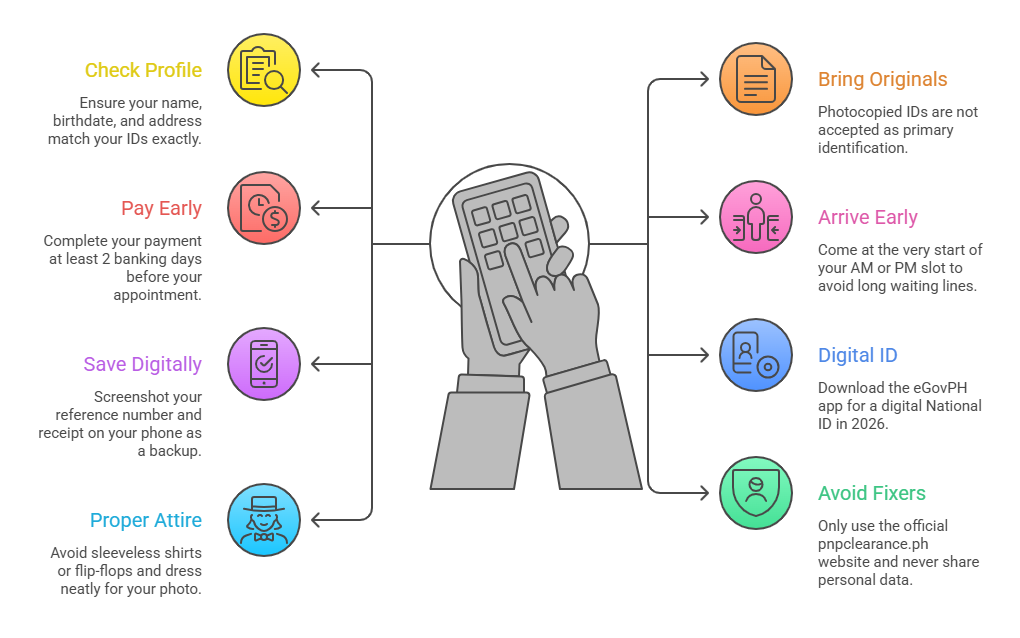
Follow these simple tips to make sure your appointment goes as smoothly as possible:
- Check your NPCS profile carefully. Your name, birthdate, and address must match your IDs exactly — even one letter off can cause a HIT delay.
- Bring originals, not photocopies. Photocopied IDs are not accepted as primary identification at the station.
- Pay early. Complete your payment at least 2 banking days before your appointment so it has time to reflect in the system.
- Arrive early. Come at the very start of your AM or PM slot to avoid long waiting lines.
- Save everything digitally. Screenshot your reference number and receipt on your phone as a backup.
- Go digital with your ID. In 2026, the Digital National ID is widely accepted. Download the eGovPH app so you always have a backup ID on your phone.
- Wear proper attire. Avoid sleeveless shirts or flip-flops. You will be photographed for the official clearance document, so dress neatly.
- Avoid fixers. Only use the official pnpclearance.ph website. Never share your reference number, QR code, or personal data with unauthorized people.
Conclusion
Preparing the correct required documents for Police Clearance 2026 is 90% of the work. If you follow this complete checklist, you can finish your application in a single visit — especially if you have a clean record with no HIT.
The most important things to remember are your two valid original IDs, your NPCS reference number, and your proof of payment. For special applicants, make sure to prepare your additional documents before your appointment day.